印尼HS Code全解析:分类逻辑、监管机制与产品编码备案实操指南
一、印尼HS Code的分类体系:从6位国际标准到8位东盟编码
1.1 全球HS编码的基础结构
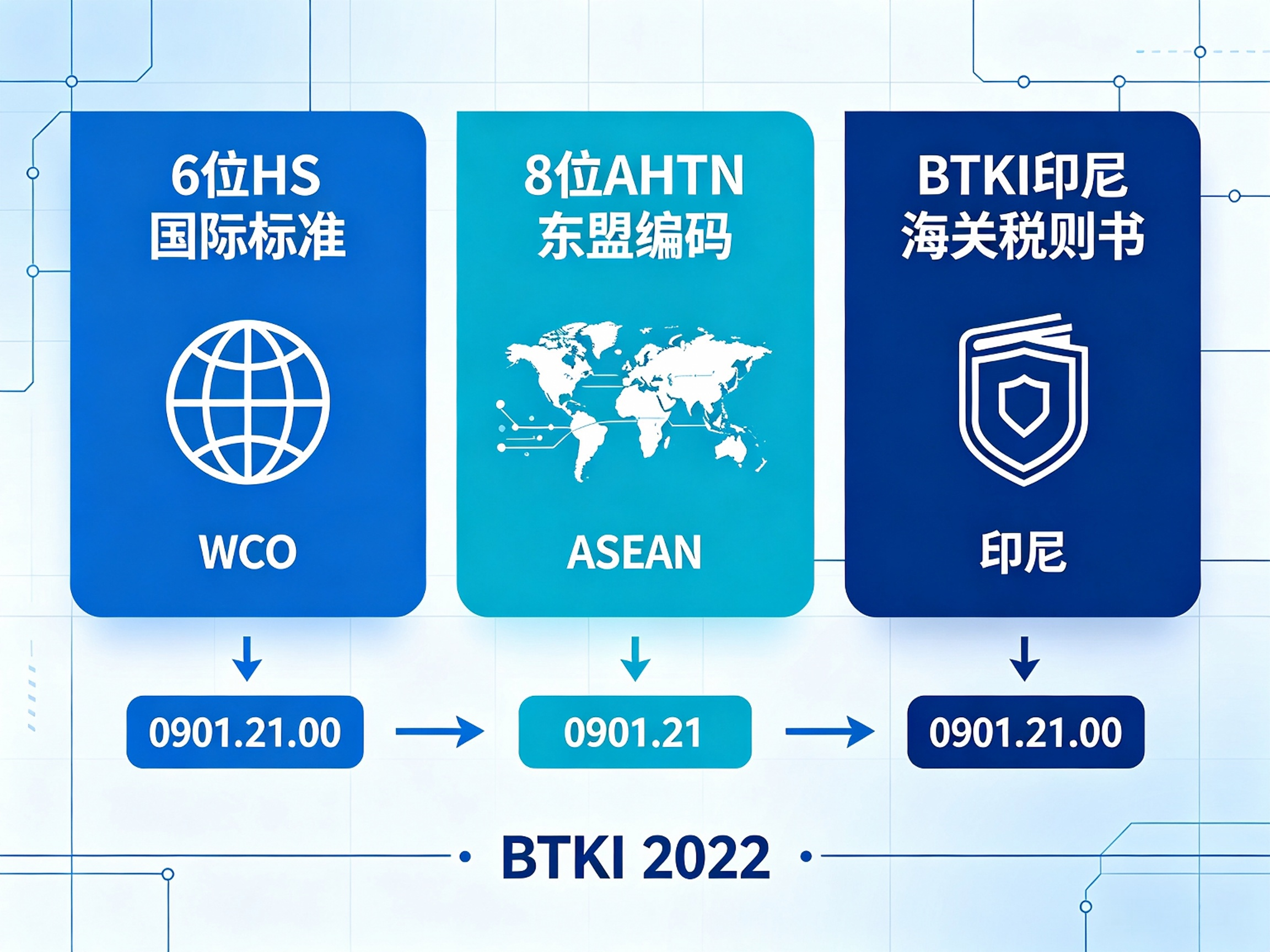
海关商品编码(Harmonized System, HS)由世界海关组织(WCO)制定,是全球统一的商品分类工具,广泛用于关税征收、贸易统计、原产地规则和进出口监管等领域。HS编码的基本结构为6位数字:前2位代表“章”(Chapter),用于区分商品大类;中间2位代表“品目”(Heading);后2位代表“子目”(Subheading)。例如,第09章涵盖咖啡、茶和香料,品目0901专指咖啡。
1.2 印尼的八位编码:AHTN的融入
印尼作为WCO成员国和东盟成员国,在6位HS编码基础上采纳了东盟统一关税命名法(ASEAN Harmonized Tariff Nomenclature, AHTN),将编码扩展至8位。AHTN是在HS基础上增加2位数字形成的区域统一编码,确保所有东盟成员国使用一致的8位分类结构,即“6位HS + 2位AHTN”。
印尼的官方关税分类文件为《印尼海关税则书》(Buku Tarif Kepabeanan Indonesia, BTKI),目前适用版本为BTKI 2022,自2022年4月1日起生效。值得注意的是,2017年之前印尼曾使用10位编码,其中最后2位为印尼本国标识;自2017年3月1日起,为配合东盟经济共同体建设和东盟单一窗口的推进,BTKI正式简化为8位编码体系。当前AHTN 8位编码的副标题总数约为10,826个。
1.3 分类的核心工具:GIR规则
当商品可能归入多个品目时,需依据HS的“一般解释规则”(General Interpretative Rules, GIR)进行判定。GIR 1至GIR 6构成了一个完整的分类逻辑链:GIR 1确定品目条文的基本解释原则;GIR 2处理未完成品和混合物的归类;GIR 3处理多品目竞合时选择最具体品目的规则;GIR 4适用于无直接对应品目时的“最相似商品”原则;GIR 5和GIR 6则分别处理包装和子目层级的分类问题。
二、HS Code背后的监管逻辑:从关税到LARTAS
2.1 HS编码决定的三层义务
在印尼进口体系中,HS编码不只是一个关税参照号,而是触发全部监管义务的核心枢纽。一个正确的HS编码直接决定以下三层义务:
第一层:关税与税费。 印尼进口关税税率分布于0%至40%区间(部分商品可达150%),增值税(PPN)自2025年1月1日起由11%上调至12%。HS编码还决定是否适用反倾销税、保障措施税等贸易救济措施,例如2026年1月印尼对进口棉织物征收保障措施关税(BMTP),覆盖BTKI 2022中16个8位HS编码项下的商品。
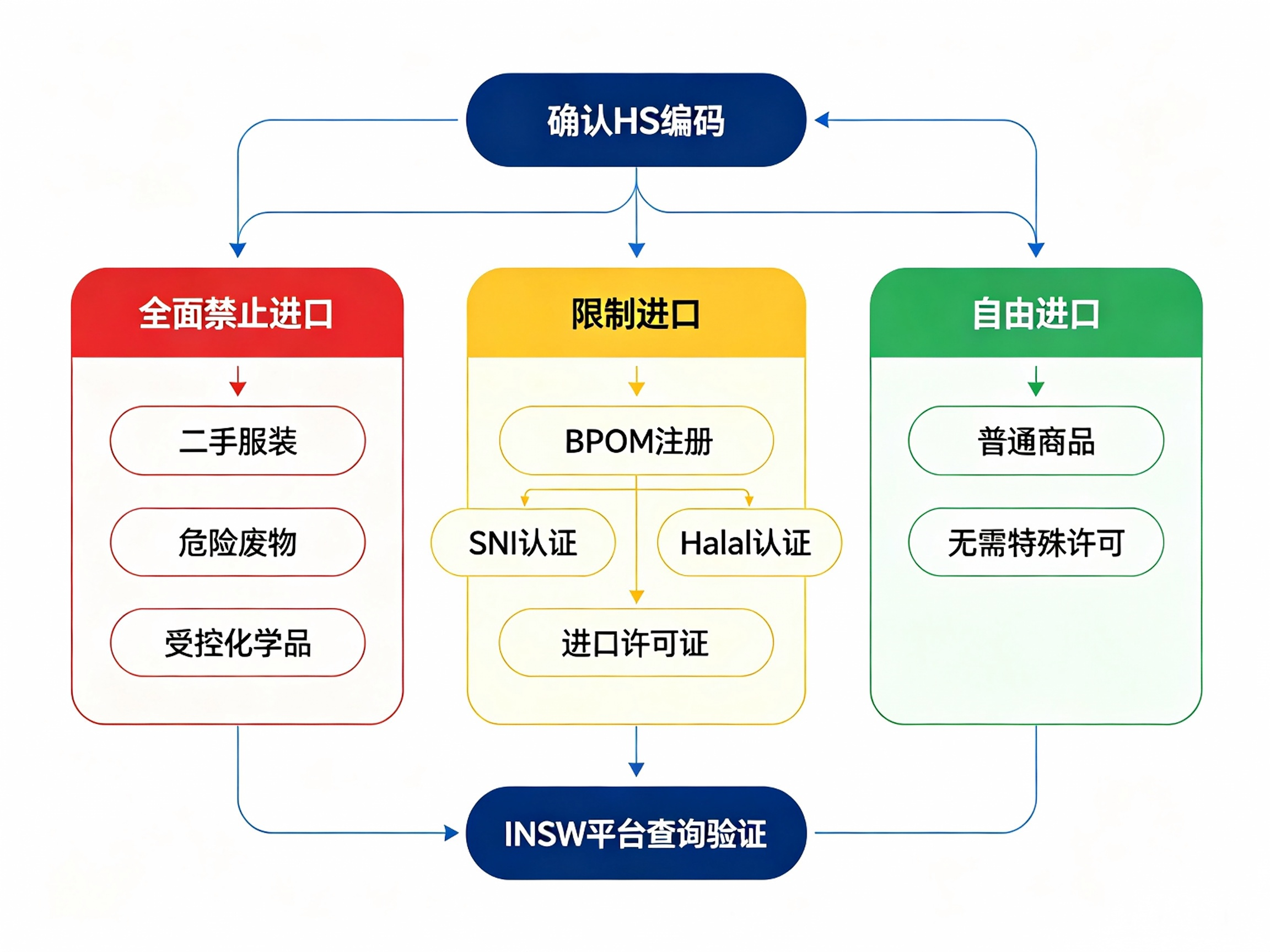
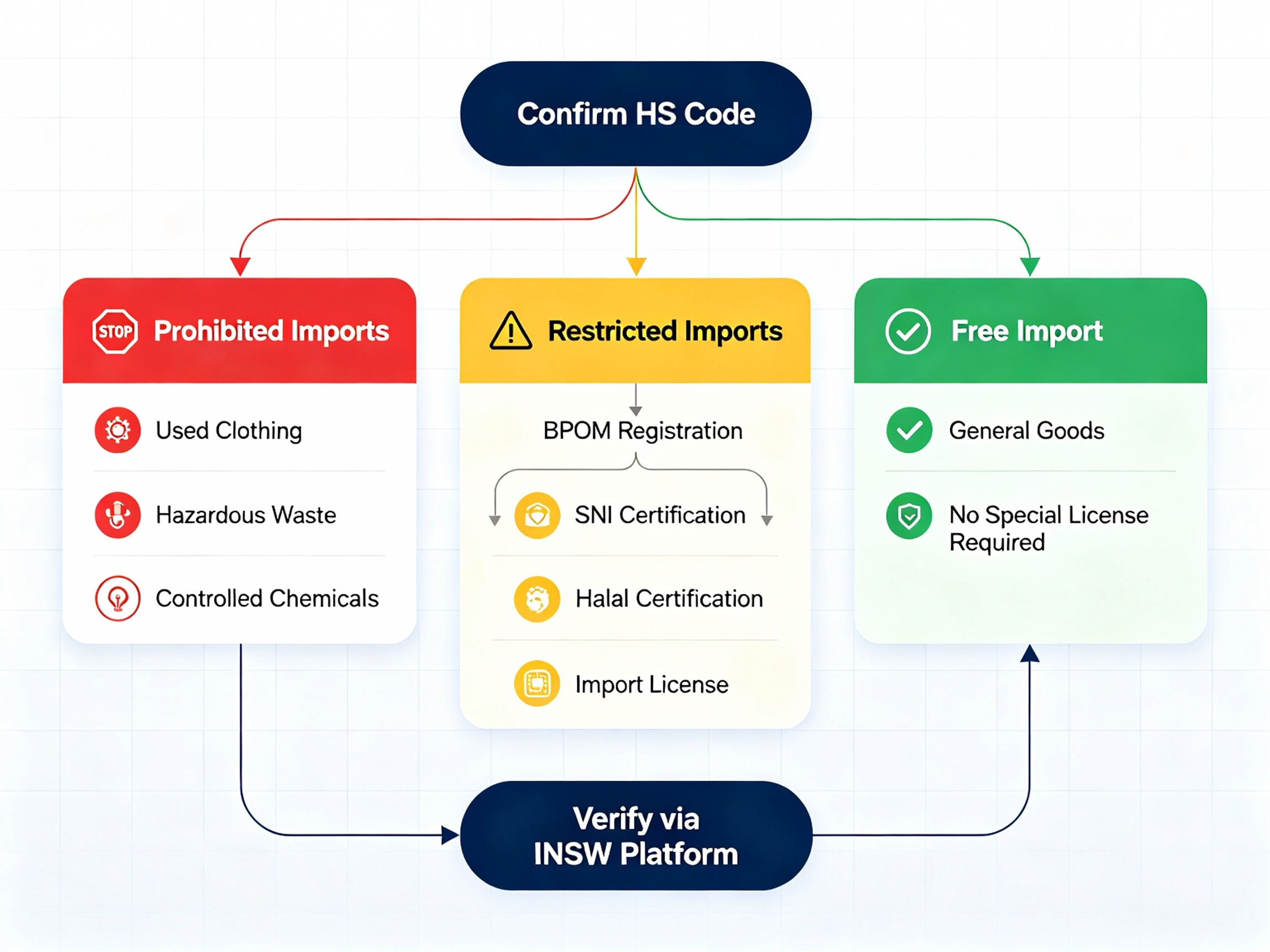
第二层:LARTAS监管。 LARTAS(Larangan dan/atau Pembatasan)即“禁止和/或限制”制度,是印尼进口监管的核心框架。根据该制度,商品被划分为“全面禁止进口”和“限制进口(需技术许可)”两大类。全面禁止类包括二手服装、危险废物(B3材料)、特定高风险化学品等;限制类则涵盖化妆品、食品饮料、医疗器械、电子产品、玩具、电池及化工产品等,进口商须取得相应技术机构的批准方可清关。
第三层:认证与许可。 HS编码决定产品是否需要BPOM注册(食品、药品、化妆品)、SNI强制认证(电子电器、玩具等工业产品)或Halal认证(食品饮料等)。印尼工业部发布的强制SNI管制产品目录中,每个产品大类均列明对应的HS编码——产品HS编码落在目录内即须强制认证,不在目录内则无需。
2.2 LARTAS的最新政策动向
2025年,印尼政府密集出台了一系列进口监管改革措施。贸易部长条例Permendag 16/2025引入基于商品集群的监管体系,针对电子产品、纺织品、化学品和农产品等分别适用定制化的进口条件。同时,政府放宽了10类主要商品的进口限制,包括林产品、补贴肥料、塑料原料等,涉及482个HS编码的LARTAS放松管制。2026年1月1日起生效的Permendag 47/2025进一步更新了禁止进口商品清单,对高健康、安全和环境风险的商品进行了重新分类。
2.3 监管协调机制
印尼的HS编码监管并非海关单一部门的职责。BTKI的制定涉及海关总署(DJBC)、财政部财政政策局(BKF)以及工业部、农业部、海洋渔业部、能源矿产部、环境林业部、国家食品药品监督管理局(BPOM)等多个机构。进口商需通过印尼国家单一窗口(INSW)平台查询特定HS编码对应的全部监管要求,包括适用的关税税率、LARTAS状态以及所需许可证类型。

三、企业如何为产品备案正确的HS编码
3.1 编码确认的第一步:产品特征分析
HS编码分类不能仅凭商品名称判断,必须从产品的材质、功能、结构、成分等物理和技术特征出发进行综合分析。具体而言,企业应准备以下信息:主要材料构成、核心功能与用途、产品形态(原料/半成品/成品)、工作原理(手动/电动/机械)以及包装方式等。这些信息构成了后续在BTKI中比对标目的基础。
3.2 第二步:利用INSW平台查询和验证
印尼国家单一窗口(INSW)提供了官方、最新的HS编码查询与监管信息查询功能。进口商可通过以下步骤进行查询:访问INSW官网(insw.go.id/intr),在搜索栏中输入候选HS编码(无需输入小数点),系统将显示该编码对应的商品描述、进口关税税率、增值税税率,以及是否属于LARTAS限制类商品、涉及哪些监管机构等信息。
INSW平台还设有贸易模拟功能(Trade Simulation Application),允许用户输入特定HS编码后,一次性列出所需的全部关税、许可证和认证要求,这是企业在产品备案阶段进行合规预判的高效工具。
3.3 第三步:申请PKSI事前裁定
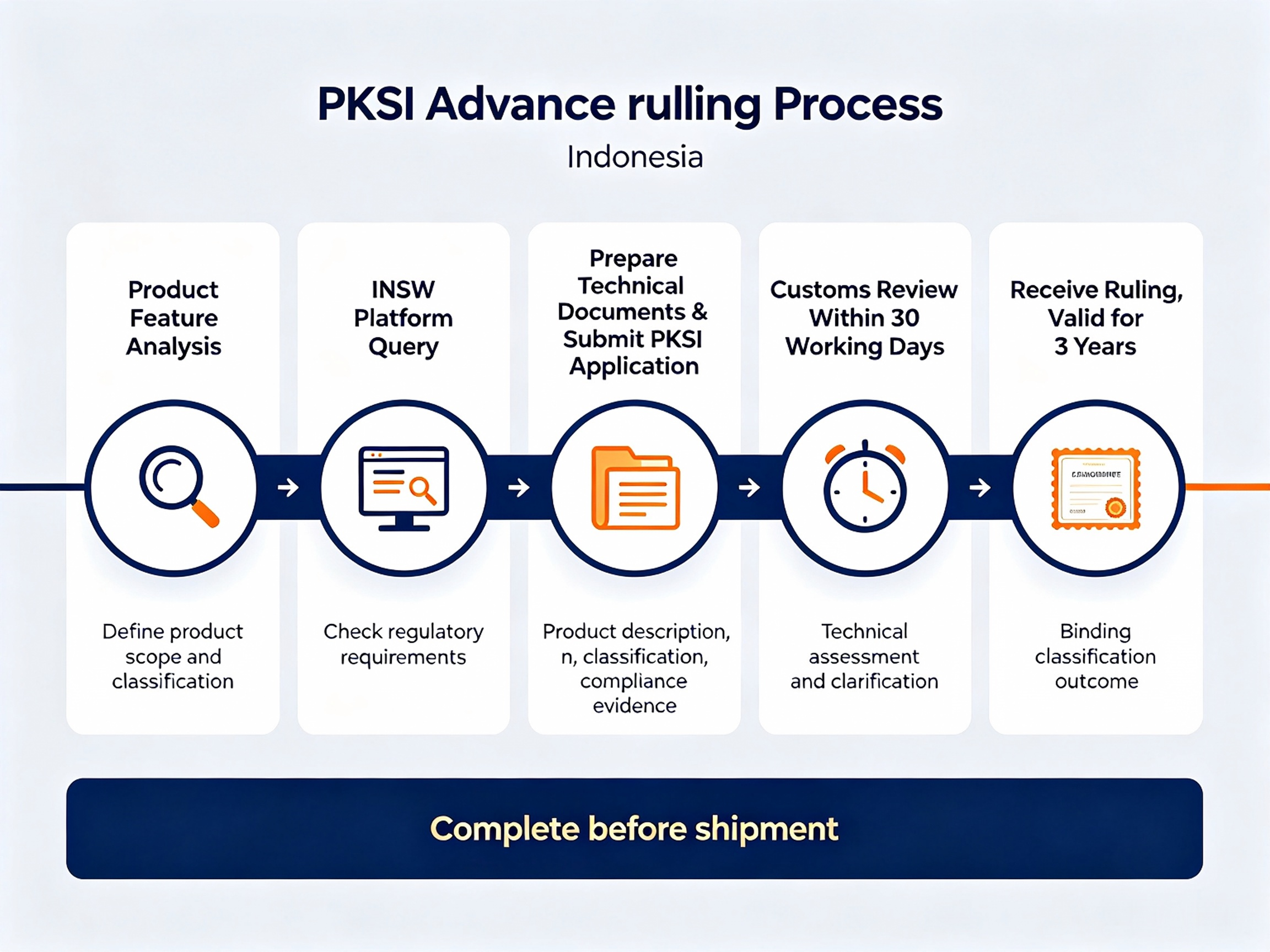
对于分类存在争议或不确定的产品,印尼海关提供了PKSI(Penetapan Klasifikasi Sebelum Impor,进口前分类裁定)机制。进口商可在货物发运前,向海关总署申请HS编码的事前裁定,以获得具有法律确定性的编码认定。
申请条件: 申请人须持有海关活动身份编号(NIK),尚未就同一商品提交进口申报(PIB),且该商品不在税务法庭的申诉或上诉程序中。
所需材料: 申请时需填写PMK 194/2016附件A格式的申请书,并附上产品技术资料,包括商标、图片/宣传册、产品规格书、材料证明(Mill Certificate)、生产流程图、材料安全数据表(MSDS)、分析证书(COA)以及海关实验室或其他实验室的检测报告。
审批时限: 海关总署在完整受理申请后30个工作日内以书面形式通知分类审查结果。PKSI决定自签发之日起3年内有效,如对决定有异议,可在决定日30日内附新证据申请复审。
3.4 第四步:确保编码与认证体系的一致性
HS编码确定后,企业须确保编码与产品备案文件、海关申报文件、认证证书中的产品描述完全一致。实际操作中,发票上的产品描述与SNI证书上的型号存在细微差异即可引发海关质疑,例如证书型号为“SA-2023”而发票显示“SA-2023 White”,这种差别可能导致清关延误。HS编码与产品清单不匹配也是印尼产品注册中常见的合规问题之一。
四、编码错误的风险与防范
4.1 编码错误的常见后果
HS编码错误是印尼进口清关延误的首要原因之一。错误编码可能导致的后果包括:清关延误、海关事后审计发现、追溯补征关税和税款、许可证不匹配、货物被扣留甚至退运。数据显示,近三分之一的报关单仍存在分类错误,而一个数字的差异就可能使产品从免税变为适用10%的税率。
4.2 防范策略
企业应建立系统化的HS编码管理流程:在出口合同签订阶段即完成HS编码的初步确认和LARTAS状态查询;对于复杂或争议品目,提前申请PKSI以锁定编码;将HS编码确认纳入公司内部的贸易合规审核流程,确保产品规格书、认证文件、贸易单证中的产品描述保持高度一致;在首次进口完成后,将分类依据和判断逻辑文档化,形成可复用的知识库。
Indonesia HS Code Complete Guide: Classification Logic, Regulatory Mechanisms, and Product Code Registration Best Practices
I. Indonesia's HS Code Classification System: From 6-Digit International Standard to 8-Digit ASEAN Code

1.1 The Global Foundation of HS Codes
The Harmonized System (HS) was developed by the World Customs Organization (WCO) as a globally unified commodity classification tool, widely used for tariff collection, trade statistics, rules of origin, and import/export regulation. The basic structure of an HS Code consists of 6 digits: the first 2 digits represent the "Chapter" (broad category of goods); the middle 2 digits represent the "Heading"; and the last 2 digits represent the "Subheading." For example, Chapter 09 covers coffee, tea, and spices, while heading 0901 specifically refers to coffee.
1.2 Indonesia's 8-Digit Code: Integration of AHTN
As a WCO member and ASEAN member state, Indonesia has adopted the ASEAN Harmonized Tariff Nomenclature (AHTN) on top of the 6-digit HS Code, extending the code to 8 digits. AHTN adds 2 digits to the HS structure, ensuring all ASEAN member states use a consistent 8-digit classification: "6-digit HS + 2-digit AHTN".
Indonesia's official tariff classification document is the Indonesian Customs Tariff Book (Buku Tarif Kepabeanan Indonesia, BTKI), with the current version being BTKI 2022, effective since April 1, 2022. Notably, before 2017 Indonesia used 10-digit codes, where the last 2 digits served as a national identifier. Since March 1, 2017, BTKI has been simplified to an 8-digit coding system to support the ASEAN Economic Community and the ASEAN Single Window initiative. The current AHTN 8-digit level contains approximately 10,826 subheadings.
1.3 The Core Classification Tool: GIR Rules
When a product could potentially fall under multiple headings, classification must follow the General Interpretative Rules (GIR) of the HS. GIR 1 through GIR 6 form a complete classification logic chain: GIR 1 establishes the basic interpretation principles for heading texts; GIR 2 addresses unfinished goods and mixtures; GIR 3 handles conflicts between multiple headings by selecting the most specific; GIR 4 applies the "most similar goods" principle when no direct heading exists; GIR 5 and GIR 6 address packaging and subheading-level classification respectively.
II. The Regulatory Logic Behind HS Codes: From Tariffs to LARTAS
2.1 Three Layers of Obligations Determined by HS Codes
In Indonesia's import system, the HS Code is not merely a tariff reference number—it is the central hub that triggers all regulatory obligations. A correct HS Code directly determines the following three layers of obligations:
Layer 1: Tariffs and Taxes. Indonesia's import duty rates range from 0% to 40% (up to 150% for certain goods), and the Value Added Tax (PPN) was raised from 11% to 12% effective January 1, 2025. The HS Code also determines whether anti-dumping duties or safeguard measures apply—for example, in January 2026, Indonesia imposed safeguard duties (BMTP) on imported cotton woven fabrics, covering 16 eight-digit HS tariff lines under BTKI 2022.
Layer 2: LARTAS Regulation. LARTAS (Larangan dan/atau Pembatasan), meaning "Prohibition and/or Restriction," is the core framework of Indonesia's import regulation. Under this system, goods are divided into "fully prohibited imports" and "restricted imports (requiring technical permits)." Fully prohibited items include second-hand clothing, hazardous waste (B3 materials), and certain high-risk chemicals. Restricted categories cover cosmetics, food and beverages, medical devices, electronics, toys, batteries, and chemical products, which require approval from relevant technical agencies before customs clearance.
Layer 3: Certification and Licensing. The HS Code determines whether a product requires BPOM registration (food, drugs, cosmetics), mandatory SNI certification (electronics, toys, and other industrial products), or Halal certification (food and beverages). Each product category listed in the Ministry of Industry's mandatory SNI control catalog specifies corresponding HS Codes—if a product's HS Code falls within the catalog, certification is mandatory; if not, it is exempt.
2.2 Latest LARTAS Policy Developments
In 2025, the Indonesian government introduced a series of import regulation reforms. Minister of Trade Regulation Permendag 16/2025 introduced a commodity cluster-based system applying tailored import conditions to electronics, textiles, chemicals, and agricultural products. Meanwhile, the government relaxed import restrictions on 10 major commodity groups, including forestry products, subsidized fertilizers, and plastic raw materials, involving LARTAS deregulation for 482 HS codes. Permendag 47/2025, effective January 1, 2026, further updated the prohibited import list by reclassifying goods with high health, safety, or environmental risks.
2.3 Regulatory Coordination Mechanism
HS Code regulation in Indonesia is not the sole responsibility of customs. The formulation of BTKI involves the Directorate General of Customs and Excise (DJBC), the Fiscal Policy Agency (BKF) of the Ministry of Finance, as well as the Ministry of Industry, Ministry of Agriculture, Ministry of Marine Affairs and Fisheries, Ministry of Energy and Mineral Resources, Ministry of Environment and Forestry, the National Agency of Drug and Food Control (BPOM), and other agencies. Importers should use the Indonesia National Single Window (INSW) platform to check all regulatory requirements associated with a specific HS Code, including applicable tariff rates, LARTAS status, and required permit types.
III. How Companies Can Register the Correct HS Code for Their Products
3.1 Step 1: Product Feature Analysis
HS Code classification cannot be determined solely by product name—it requires comprehensive analysis of the product's material composition, function, structure, and chemical composition. Specifically, companies should prepare the following information: primary material composition, core function and use, product form (raw material/semi-finished/finished), operating principle (manual/electric/mechanical), and packaging method. This information forms the basis for comparing headings in the BTKI.
3.2 Step 2: Query and Verify via the INSW Platform
The Indonesia National Single Window (INSW) provides official, up-to-date HS Code lookup and regulatory information query functions. Importers can follow these steps: visit the INSW website (insw.go.id/intr), enter the candidate HS Code in the search bar (without decimal points), and the system will display the corresponding product description, import duty rate, VAT rate, and whether the item is subject to LARTAS restrictions and which regulatory agencies are involved.
The INSW platform also features a Trade Simulation Application, which allows users to input a specific HS Code and obtain a comprehensive list of all required tariffs, permits, and certification requirements at once—an efficient tool for compliance pre-assessment during the product registration stage.
3.3 Step 3: Apply for a PKSI Advance Ruling
For products with disputed or uncertain classification, Indonesia Customs offers the PKSI (Penetapan Klasifikasi Sebelum Impor—Pre-Import Classification Determination) mechanism. Importers can apply to the Directorate General of Customs and Excise for an advance ruling on the HS Code before shipment, obtaining a legally binding classification determination.
Application Conditions: The applicant must hold a customs activity identity number (NIK), must not have already submitted an import declaration (PIB) for the same goods, and the goods must not be under objection or appeal proceedings at the tax court.
Required Materials: The application must use the format specified in Appendix A of PMK 194/2016, accompanied by product technical documentation including trademark, images/brochures, product specifications, mill certificates, production flow charts, Material Safety Data Sheets (MSDS), Certificates of Analysis (COA), and test reports from the customs laboratory or other laboratories.
Processing Timeline: The Directorate General of Customs and Excise will notify the classification review result in writing within 30 working days of receiving a complete application. A PKSI decision is valid for 3 years from the date of issuance. If the decision is disputed, a review application with new evidence may be submitted within 30 days of the decision date.
3.4 Step 4: Ensure Consistency Between Codes and Certification Systems
Once the HS Code is determined, companies must ensure that the code matches the product description in registration files, customs declaration documents, and certification certificates. In practice, even a minor discrepancy between the invoice product description and the model number on the SNI certificate—such as the certificate showing "SA-2023" while the invoice displays "SA-2023 White"—can trigger customs scrutiny and cause clearance delays. Mismatches between the HS Code and the product list are also a common compliance issue in Indonesian product registration.
IV. Risks of Misclassification and Prevention Strategies
4.1 Common Consequences of Misclassification
HS Code errors are one of the leading causes of import clearance delays in Indonesia. Potential consequences include: clearance delays, post-clearance audit findings, backdated duty and tax assessments, license mismatches, goods being held or even returned. Data shows that nearly one-third of customs declarations still contain classification errors, and a single digit difference can quickly change a product from duty-free to a 10% tariff rate.
4.2 Prevention Strategies
Companies should establish a systematic HS Code management process: complete preliminary HS Code confirmation and LARTAS status checks at the export contract stage; apply for PKSI in advance for complex or disputed items to lock in the classification; integrate HS Code verification into the company's internal trade compliance review process to ensure consistency across product specifications, certification documents, and trade documents; and after the first import is completed, document the classification rationale and judgment logic to form a reusable knowledge base.