东南亚很热,但你的第一个海外市场真的是它吗?
最近在推进企业出海的过程中,我被老板们问得最多的问题是:
东南亚现在还能不能做?印尼政策是不是收紧了?越南是不是比泰国机会更大?现在进去还来得及吗?
这些问题背后,其实不是企业不知道要出海。恰恰相反,很多制造业企业已经有了很强的出海意识。真正难的是:第一个海外市场,到底应该选哪里?
很多企业做市场选择时,第一反应是看哪个国家更热,哪个市场规模更大,哪个区域新闻更多。但一个市场很好,和这个市场适合你,是两回事。
东南亚很热,不代表你现在进得去;市场规模很大,不代表你的产品能成交;增长很快,不代表你能以可承受成本跑出第一笔订单。
企业第一个海外市场,不一定要选最大的,而应该优先选择最有可能以可承受成本,跑出第一笔可复制订单的市场。
海外0-1阶段,市场选择的目标不是最大化市场规模,而是降低验证成本,提高学习速度。这篇文章,我想把自己在真实项目里反复使用的一套判断方法写下来——不是告诉你东南亚哪个国家一定好,而是帮你建立一个判断框架:当印尼、越南、泰国、菲律宾、马来西亚都摆在面前时,你到底应该先看什么。

一、看市场之前,先看企业自己
我现在判断一个海外市场,第一步不是打开世界地图,而是先看企业自身。
东南亚有超6亿人口,GDP规模接近4万亿美元,2025年东盟11国居民最终消费支出突破6000亿美元。但这些宏观数字和你有什么关系?真正的问题不是东南亚有没有机会,而是你自己有没有能力接住这个机会。
所以我会先问企业几个很具体的问题:
你的产品现在主要卖给谁?你的优势是价格、设计、定制、交付,还是服务?你的产品进入当地市场需要哪些认证(SNI、BPOM、清真认证等)?如果客户要小批量试单,你能不能接?如果客户要长期合作,你有没有稳定交付能力?如果出现售后问题,谁来响应?
这些问题看起来很基础,但很多企业恰恰是在这里开始分化。
有些企业产品不错,但认证准备不足。印尼自2026年10月17日起,物流及化妆品行业将强制实行清真认证准入——如果产品在强制目录内却没有认证,货物可能被扣留、退运甚至销毁。有些企业报价有优势,但交付周期无法匹配当地客户节奏。有些企业工厂能力强,但没有英文资料、案例、样品、服务承诺——客户很难建立信任。
市场机会是外部的,能不能接住,首先取决于企业自己。出海第一站,不是先问世界哪里有机会,而是先问自己有什么能力。
二、不要先看市场有多大,要看谁正在买
很多企业研究海外市场,最容易从宏观数据开始。GDP多少,人口多少,进口额多少,行业增长多少。
这些数据当然有价值。但问题是,宏观数据不会直接给你订单。
GDP不会给你下订单,人口也不会给你回邮件。真正决定企业能不能进入一个市场的,是有没有具体客户正在买,为什么买,从谁那里买,以及他们现在的不满在哪里。
所以我现在更关注需求侧的证据。
海外正在发生什么需求?谁正在采购这类产品?客户最在意价格、交期、认证、设计,还是本地服务?现有供应商哪里没有满足?中国供应链到底适合解决其中哪一类问题?
这里至少要看三类证据:
第一类是需求证据。 当地是否有稳定应用场景?是否有持续采购需求?是否有终端消费者或工程客户的真实使用需求?比如东南亚电商市场2025年交易额达1576亿美元,同比增长22.8%,较2020年增长近3倍——这是一个明确的增量市场信号。
第二类是客户证据。 当地采购商、经销商、工程商、零售商是否愿意回复?是否愿意进一步沟通?是否愿意看样品或方案?有数据显示,东南亚消费者正从“图便宜”转向“要品质”——约九成受访者表示愿意为品牌商品支付更高价格。如果你的产品定位在中高端,这个信号值得重视。
第三类是交易证据。 当地是否已有类似产品在销售?交易价格区间在哪里?客户为什么换供应商?试单门槛高不高?
很多企业的问题,是把“应该有需求”误判成“已经有订单”。“应该有需求”和“已经有人买”,中间隔着的不是一份研究报告,而是一张订单。
三、企业优势不等于市场优势
还有一个误区,我在出海项目里经常看到。企业会很自然地说:我们有价格优势,我们质量很好,我们交付很快,我们可以定制,我们的供应链很完整。
这些优势都重要。但进入海外市场以后,企业认为的优势,不一定会自动变成客户愿意付钱的价值。
价格优势,到岸以后还有优势吗?交付优势,客户需要的是工厂出货快,还是当地随时能补货?质量优势,客户通过什么证据相信你质量好?定制能力,客户是否真的愿意为定制支付更高沟通成本?
我越来越觉得,企业不能只用自己的语言描述优势,而要用客户的语言重新翻译优势。
客户不愿意付钱的优势,很难成为真正的市场优势。
以东南亚为例,单纯依靠低价、补贴和粗放铺货越来越难形成长期优势。Lazada数据显示,品牌授权网店销售占比已从2020年的12%增长到2025年的30%。品牌化、品质化正在成为新的竞争维度。
所以,判断第一个海外市场时,企业不应该只问“我有什么优势”,还要继续问:这个市场的客户是否在意这个优势?这个优势是否影响成交?有没有证据证明它真的有用?
四、第一个海外市场,更应该看离订单有多远
很多企业喜欢选大市场。东南亚有6.8亿人口,70%以上是中青年,当然有吸引力。
但第一个海外市场,如果只看市场规模,很容易把企业带进高成本验证。
有些市场规模很大,但可能需要两年认证、需要重资产投入、需要本地团队、需要库存、需要复杂渠道、还需要很强的品牌认知。这样的市场不是不能做,而是不一定适合0-1阶段。
相反,有些市场可能规模没有那么大,但三个月内就能接触精准客户,完成样品沟通、报价、试单,并拿到足够真实的反馈。
对第一次进入海外市场的企业来说,后者往往更有价值。因为0-1阶段最重要的不是做大,而是验证。
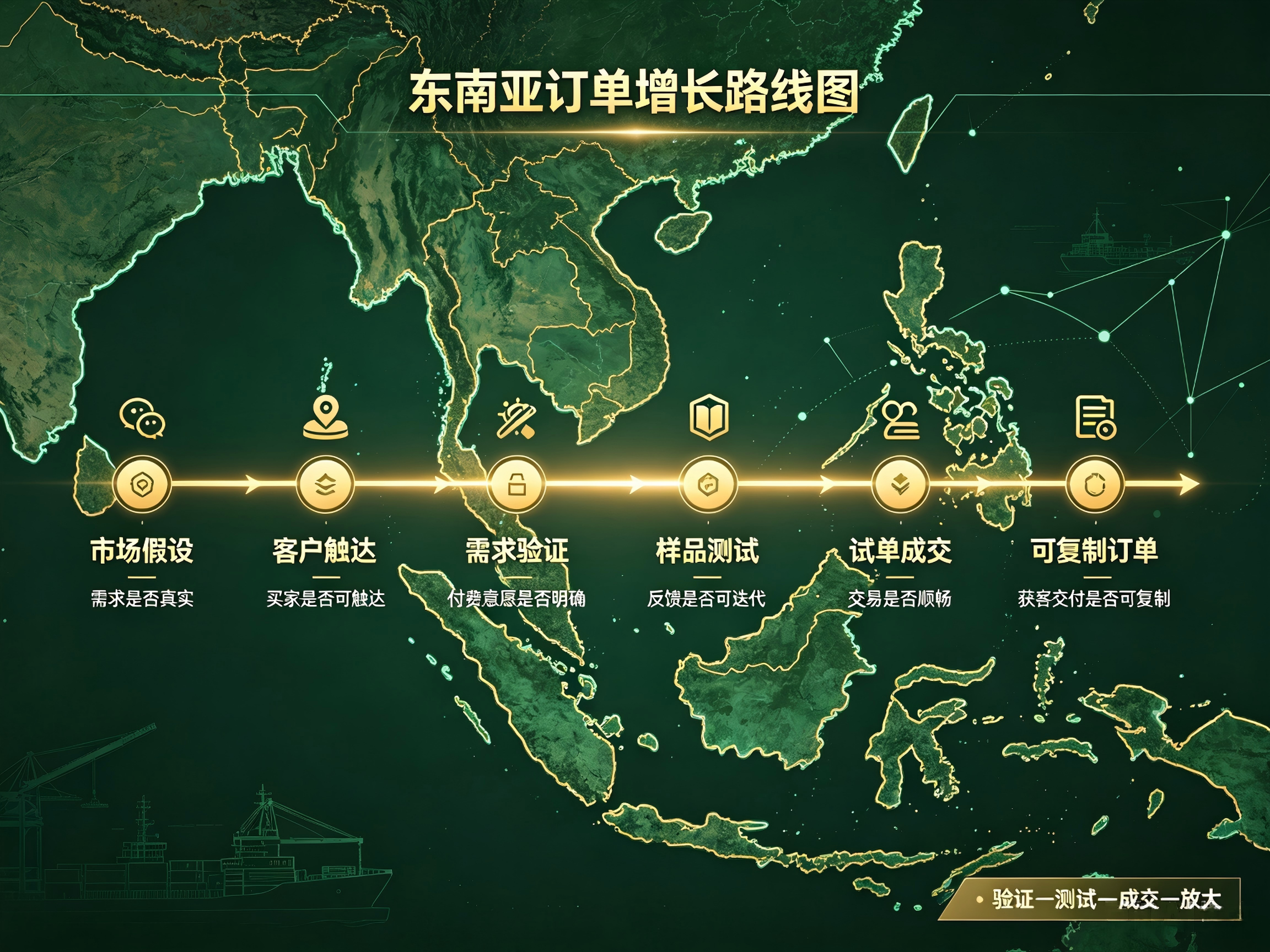
验证客户是谁,验证产品是否匹配,验证价格是否可接受,验证渠道是否能进入,验证交付是否能承接,验证企业有没有持续获得海外订单的能力。
所以我会至少算六笔账:认证成本、渠道成本、获客成本、交付成本、时间成本、退出成本。
如果一个市场机会看起来很大,但认证投入高、获客周期长、库存压力大、退出成本高,那么它未必适合作为第一站。一个适合0-1验证的市场,不仅要有增长上限,还必须输得起。
2026年的东南亚,多国正在推进电商税改、收紧低价进口包裹免税、将社交电商和直播电商纳入监管。泰国已取消小额免税,综合税率从7%飙升至17.7%;越南工贸部已启动针对Shopee与TikTok Shop的反垄断调查。这些政策变化本身就是进入门槛的一部分——算不清这些账,就不该贸然进入。
五、不是用50页报告决定市场,而是用真实客户验证市场
我现在越来越不愿意只停留在报告层面。报告可以帮助我们建立假设,但市场到底对不对,最终要让客户回答。
所以我更关注如何获得前20-50个精准客户,以及这些客户反馈了什么。
客户从哪里来?有没有采购?从哪里采购?最关心什么?愿不愿意回复?愿不愿意开会?愿不愿意看样?愿不愿意报价?有没有试单机会?
这些反馈,比一句“这个市场有机会”更重要。
因为每一次回复、拒绝、沉默、追问、会议、报价,都是市场给企业的真实信号。有时候,客户不回复,也是一种反馈。它可能说明客户画像不准,价值表达不清,产品不匹配,或者进入时机不对。
企业做市场验证最重要的目的,不是证明老板是对的,而是尽可能便宜、尽可能早地发现自己哪里错了。
市场研究最大的价值,不是让你更敢投入,而是让你少做错误投入。
六、东南亚市场五维验证模型
如果把前面的判断沉淀成一个模型,我现在会用五个维度看一个海外市场,我把它称为东南亚市场五维验证模型。它不是为了给企业一个标准答案,而是帮助企业把“我觉得这个市场不错”,变成一组可以验证的经营假设。
第一维:市场需求真实性。 当地是否有真实、持续、可触达的需求?不是“应该有”,而是“确实在买”。东南亚电商渗透率仅11%,较国内市场仍有2倍以上增长空间——这是增量,但增量不等于你的订单。
第二维:企业能力匹配度。 你的产品、价格、交付、认证、服务能力,是否匹配这个市场的客户预期?如果能力不匹配,再大的市场也与你无关。
第三维:进入门槛可承受性。 认证成本、渠道成本、获客成本、时间成本——这些投入是否在企业可承受范围内?印尼中期不再提高税率,但数字化稽查全面上线,“低报货值+灰清+个人渠道发货”的老路正在被系统截断。合规本身就是成本。
第四维:验证可行性。 能否在合理时间内(3-6个月)完成小规模验证?能否接触到足够数量的精准客户并获取真实反馈?
第五维:订单可复制性。 如果第一笔订单跑通了,能否形成可复制的获客和交付模式?还是每笔订单都要从头开始?
我建议企业在早期同时选择2-3个东南亚国家作为候选市场,每个维度做初步判断。但一定要记住,分数不是答案,评分只是帮助企业把模糊感觉拆开,把判断变得可讨论、可比较、可验证。最终答案仍然来自真实客户反馈。
如果一个市场需求真实,企业能力匹配,进入门槛可承受,可以小规模验证,而且离第一笔订单更近,它就更适合作为企业的第一站。
七、市场能力不是一次选择,而是持续修正
真正成熟的市场能力,不是一次性选对某个国家。而是在不断接触客户、不断获得反馈、不断修正判断的过程中,让企业越来越接近真实订单。
企业要持续关注:客户最近问什么?哪些询盘增加?为什么没有成交?报价为什么被拒?竞争对手怎么变化?哪些假设被证明错误?
这些信息不能只停留在销售手里,它要反馈给产品、供应链、品牌和管理层。
客户说交期太长,可能不是销售问题,而是供应链问题。客户说价格高,可能不是单纯降价,而是价值表达不够清楚。客户问认证,可能说明市场门槛比想象中更高。客户持续追问售后,可能说明企业需要更早设计本地服务方案。
墨腾创投创始人李江玕有一个判断:东南亚并非统一市场,而是由多个语言、文化、宗教、消费习惯迥异的国家构成的复杂拼图。出海品牌切忌对六国市场采取一刀切扩张策略,不能只依靠宏观数据和案头研究做决策,还需要重视实地调研和一线验证。
所以海外市场选择不是一个静态动作,它更像一个循环:看自己→找需求→验价值→算门槛→小验证→快复盘。
只有持续修正,企业的市场判断才会越来越接近真实世界。

写在最后:真正值得进入的市场,是被验证出来的
这几年我的一个变化是:
过去,我更关注哪里有资源。后来,我更关注哪里有机会。现在,我更关注什么机会可以通过低成本验证,最终变成可复制的订单。
因为资源很多,但不是每个资源都会变成增长。机会很多,但不是每个机会都适合企业现在进入。
东南亚有6.8亿人口、1576亿美元的电商交易额、22.8%的年增速——这些数字很诱人。但真正值得进入的市场,不是地图告诉你的,不是报告告诉你的,甚至不是专家告诉你的——而是客户、订单和持续反馈共同验证出来的。
对企业出海来说,第一站选哪里,表面上是市场问题,本质上是企业全球经营能力的问题。
你能不能判断客户?能不能验证需求?能不能承接交付?能不能快速复盘?能不能把一次试单变成可复制订单?
这才是全球订单增长真正要解决的问题。
接下来,我会继续按照“一个能力认知篇+一个实践篇”的方式,把市场、产品、品牌、组织、现金流、决策和全球化这七种经营能力逐一拆开,也把我在真实项目中正在验证的方法持续记录下来。
出海只是路径。全球订单增长,才是目的。
关注汇百方国际公众号,获取更多东南亚资讯和出海解决方案
Southeast Asia Is Hot, but Is It Really Your First Overseas Market?
Recently, while advising companies on their global expansion, the question I get most from business owners is:
Is Southeast Asia still a viable option now? Are Indonesia’s policies tightening? Is Vietnam a bigger opportunity than Thailand? Is it still not too late to enter now?
Behind these questions, it is not that companies don’t know they need to go global. On the contrary, many manufacturers already have a strong awareness of the need to expand overseas. What is truly difficult is: which market should you choose first?
Many companies instinctively look at which country is hotter, which market is larger, or which region is getting more media coverage. But a market being good and a market being right for you are two different things.
Southeast Asia is hot, but that does not mean you can enter it now. The market is huge, but that does not mean your product can sell there. Growth is fast, but that does not mean you can secure your first order at an affordable cost.
A company’s first overseas market should not necessarily be the largest one. Instead, it should be the one where you are most likely to generate your first scalable order at a bearable cost.
In the 0‑to‑1 stage of going global, the goal of market selection is not to maximise market size, but to reduce validation cost and accelerate learning. In this article, I want to share a set of frameworks I have repeatedly used in real projects – not to tell you which Southeast Asian country is definitely the best, but to help you build a decision framework: when Indonesia, Vietnam, Thailand, the Philippines, and Malaysia are all on the table, what should you look at first?
1. Before You Look at the Market, Look at Yourself First
When I evaluate an overseas market today, my first step is not to open a world map, but to examine the company itself.
Southeast Asia has over 680 million people, a combined GDP approaching USD 4 trillion, and household final consumption expenditure across ASEAN‑11 exceeded USD 600 billion in 2025. But what do these macro numbers have to do with you? The real question is not whether there is opportunity in Southeast Asia, but whether you have the capability to capture that opportunity.
So I start by asking companies a few very specific questions:
Who are your current main buyers? What is your competitive edge – price, design, customisation, delivery, or service? What certifications do your products need to enter the local market (e.g. SNI, BPOM, Halal)? Can you handle small trial orders? If a client wants long‑term cooperation, can you deliver reliably? If after‑sales issues arise, who will respond?
These questions seem basic, but this is exactly where many companies begin to diverge.
Some companies have good products but are unprepared for certifications. From 17 October 2026, Indonesia will mandate Halal certification for logistics and cosmetics – if your product falls under the mandatory list and lacks certification, goods can be detained, returned or even destroyed. Some companies have competitive quotes but cannot match local clients’ expected delivery timelines. Some have strong factories but lack English‑language materials, case studies, samples, or service commitments – making it hard for clients to trust them.
Market opportunities are external; whether you can seize them depends first on yourself. The first step overseas is not to ask where the world has opportunities, but to ask what capabilities you have.
2. Don’t Start with Market Size – Start with Who Is Already Buying
Many companies study overseas markets by starting with macro data. GDP, population, import value, industry growth – all are readily available.
These data points are valuable. But the problem is that macro data will not give you orders directly.
GDP will not place an order, and population will not reply to your email. What really determines whether you can enter a market is whether there are concrete customers already buying, why they buy, from whom they buy, and what their current dissatisfactions are.
So today I pay more attention to demand‑side evidence.
What demand is emerging overseas? Who is currently procuring products like yours? Do customers care most about price, lead time, certification, design, or local service? Where are existing suppliers falling short? Which specific problem can China’s supply chain best solve?
I look for at least three types of evidence:
First, demand evidence. Is there a stable application scenario? Is there ongoing procurement demand? Are there end‑users or project clients with real needs? For example, Southeast Asia’s e‑commerce market reached USD 157.6 billion in 2025, up 22.8% year‑on‑year, nearly tripling since 2020 – a clear signal of an incremental market.
Second, customer evidence. Are local buyers, distributors, contractors, or retailers willing to respond? Are they open to further communication? Are they willing to review samples or proposals? Data shows that Southeast Asian consumers are shifting from “price‑first” to “quality‑first” – about 90% of respondents say they are willing to pay more for branded products. If your product is positioned in the mid‑to‑high range, this signal deserves attention.
Third, transaction evidence. Are similar products already being sold locally? What is the price range? Why would customers switch suppliers? How high is the trial‑order barrier?
Many companies mistake “there should be demand” for “there is already an order.” Between “there should be demand” and “someone is already buying” lies not a research report, but a purchase order.
3. Your Company Advantages Are Not Automatically Market Advantages
Another misconception I often see in going‑global projects: companies naturally say, “We have price advantages, good quality, fast delivery, flexible customisation, and a complete supply chain.”
All these advantages matter. But once you enter an overseas market, what you consider advantages do not automatically translate into value that customers are willing to pay for.
Does your price advantage still hold after freight, duties, and local costs? Does your delivery advantage mean factory dispatch speed, or the ability to restock locally at any time? What evidence will customers rely on to trust your quality? Will customers really pay the higher communication cost for customisation?
I increasingly believe that companies should not describe their advantages in their own language, but translate them into the customer’s language.
An advantage that customers are unwilling to pay for is hardly a real market advantage.
Take Southeast Asia as an example – relying solely on low prices, subsidies, and undifferentiated mass listing is increasingly unsustainable. Lazada data shows that sales from authorised brand stores grew from 12% in 2020 to 30% in 2025. Branding and quality are becoming new competitive dimensions.
So when choosing your first overseas market, you should not only ask “What are my advantages?” but also ask: Do customers in this market care about these advantages? Do they influence purchase decisions? Is there evidence that they actually work?
4. For Your First Overseas Market, Look at How Close You Are to an Order
Many companies prefer large markets. Southeast Asia has 680 million people, over 70% are young – of course it is attractive.
But for a first overseas market, if you only look at market size, you can easily lead your company into high‑cost validation.
Some markets are large, but may require two years of certification, heavy asset investment, a local team, inventory, complex distribution channels, and strong brand recognition. These markets are not impossible, but they are not necessarily suitable for the 0‑to‑1 stage.
In contrast, some smaller markets may allow you to reach target customers, complete sample communication, quote, trial order, and obtain real feedback within three months.
For a company entering an overseas market for the first time, the latter is often more valuable. Because the most important thing in the 0‑to‑1 stage is not scaling, but validation.
Validate who the customer is, whether the product fits, whether the price is acceptable, whether the channel is accessible, whether delivery can be fulfilled, and whether the company can sustain a continuous flow of overseas orders.
So I calculate at least six costs: certification cost, channel cost, acquisition cost, delivery cost, time cost, and exit cost.
If a market opportunity seems large but requires high certification investment, long acquisition cycles, heavy inventory pressure, and high exit costs, it may not be suitable as your first stop. A good market for 0‑to‑1 validation not only has upside potential, but also must be affordable to lose.
In 2026, multiple Southeast Asian countries are advancing e‑commerce tax reforms, tightening duty‑free thresholds on low‑value parcels, and bringing social commerce and live‑stream commerce under regulation. Thailand has already abolished its small‑parcel duty exemption, pushing the composite tax rate from 7% to 17.7%. Vietnam’s Ministry of Industry and Trade has initiated anti‑trust investigations against Shopee and TikTok Shop. These policy changes are themselves part of the entry barrier – if you cannot properly account for them, you should not rush in.
5. Don’t Use a 50‑Page Report to Decide on a Market – Use Real Customers to Validate It
I am increasingly reluctant to stay at the report level. Reports help us build hypotheses, but whether a market is right must ultimately be answered by customers.
So I focus more on how to obtain the first 20‑50 targeted customers and what feedback they provide.
Where do customers come from? Do they have purchasing needs? Where do they currently source? What do they care about most? Are they willing to reply, meet, review samples, receive quotes, or offer a trial order?
These signals are more important than a statement like “this market has potential.”
Every reply, rejection, silence, follow‑up, meeting, and quote is a real signal from the market. Sometimes a customer’s non‑reply is also feedback – it may indicate that your customer profile is off, your value proposition is unclear, the product is mismatched, or the timing is wrong.
The most important goal of market validation is not to prove the boss right, but to discover, as cheaply and as early as possible, where you are wrong.
The greatest value of market research is not to encourage you to invest more, but to help you avoid making wrong investments.
6. A Five‑Dimensional Validation Framework for Southeast Asia
If I distill the above judgments into a model, I now use five dimensions to evaluate an overseas market – I call it the Southeast Asia Market Five‑Dimensional Validation Model. It is not meant to provide a standard answer, but to help companies turn “I think this market looks good” into a set of testable business hypotheses.
Dimension 1: Authenticity of Market Demand. Is there real, ongoing, and accessible demand? Not “there should be,” but “people are actually buying.” Southeast Asia’s e‑commerce penetration is only 11%, with more than twice the room for growth compared to the domestic market – this is incremental, but increment does not equal your orders.
Dimension 2: Alignment with Company Capabilities. Do your product, price, delivery, certification, and service capabilities match the expectations of customers in this market? If not, the size of the market does not matter.
Dimension 3: Affordability of Entry Barriers. Certification costs, channel costs, acquisition costs, time costs – are these within your company’s capacity? Indonesia has said it will not raise tax rates in the near term, but digital audits are fully online – the old paths of “under‑declaring + grey clearance + personal‑channel shipping” are being systematically blocked. Compliance itself is a cost.
Dimension 4: Feasibility of Validation. Can you complete a small‑scale validation within a reasonable timeframe (3‑6 months)? Can you reach enough target customers and obtain real feedback?
Dimension 5: Replicability of Orders. If you succeed with a first order, can you turn it into a repeatable acquisition and delivery model? Or will each order require starting from scratch?
I suggest that companies select 2‑3 Southeast Asian countries as candidate markets early on and make a preliminary assessment on each dimension. But remember, scores are not the answer – they are just a way to break down vague feelings into something discussable, comparable, and testable. The final answer always comes from real customer feedback.
If demand is real, capabilities match, entry barriers are affordable, validation is feasible, and you are closer to your first order, then that market is more suitable as your first stop.
7. Market Capability Is Not a One‑Time Choice, but Continuous Refinement
True market capability is not about picking the “right” country once. It is about getting closer and closer to real orders through continuous customer contact, continuous feedback, and continuous recalibration.
Companies should keep asking: What are customers asking about recently? Which enquiries are increasing? Why did deals not close? Why were quotes rejected? How are competitors changing? Which assumptions have been proven wrong?
This information must not stay only with the sales team – it needs to feed back into product, supply chain, brand, and management.
A customer saying lead time is too long may not be a sales issue, but a supply‑chain issue. A customer saying price is too high may not mean simply lowering price, but that the value proposition is not clear enough. A customer asking about certifications may indicate that the market barrier is higher than expected. A customer repeatedly asking about after‑sales may mean the company needs to design a local service solution earlier.
Li Jianggan, founder of Momentum Works, has observed that Southeast Asia is not a unified market, but a complex puzzle of countries with vastly different languages, cultures, religions, and consumption habits. Brands going overseas should avoid a one‑size‑fits‑all expansion strategy across six countries, and should not rely solely on macro data and desk research – field research and front‑line validation are equally essential.
So overseas market selection is not a static decision; it is more like a cycle: examine yourself → find demand → test value → calculate barriers → run small validations → review quickly. Only through continuous refinement will your market judgment increasingly align with reality.
Final Thoughts: The Market Truly Worth Entering Is Validated, Not Assumed
My own thinking has changed over the years:
In the past, I focused more on where resources were available. Later, I focused more on where opportunities existed. Now, I focus on which opportunities can be validated at low cost and eventually turned into scalable orders.
Because there are plenty of resources, but not every resource becomes growth. There are plenty of opportunities, but not every opportunity is right for your company at this stage.
Southeast Asia has 680 million people, USD 157.6 billion in e‑commerce transaction value, and 22.8% annual growth – these numbers are tempting. But the market truly worth entering is not told to you by a map, a report, or even an expert – it is validated by customers, orders, and continuous feedback.
For manufacturers going global, where to choose your first stop is, on the surface, a market question; but at its core, it is a question of your company’s capability for global operations.
Can you identify the right customers? Can you validate demand? Can you fulfil delivery? Can you review and iterate quickly? Can you turn a trial order into a scalable order model?
That is the real problem that global order growth must solve.
Going forward, I will continue to break down the seven core operational capabilities – market, product, brand, organisation, cash flow, decision‑making, and globalisation – in a pattern of “one cognitive piece + one practical piece,” and keep documenting the methods I am testing in real projects.
Going global is only the path. Global order growth is the destination.